IBM’s big computers of the 1960s to early 1990s were cooled partly with water.[1,3] In the mid-1990s, lower-power CMOS chips let IBM’s servers switch to air.[1] Now the newest AI racks are designed to be cooled entirely by liquid, with warm-water designs, sealed closed loops, and in some places waste heat sent to homes nearby.[2,4,5]
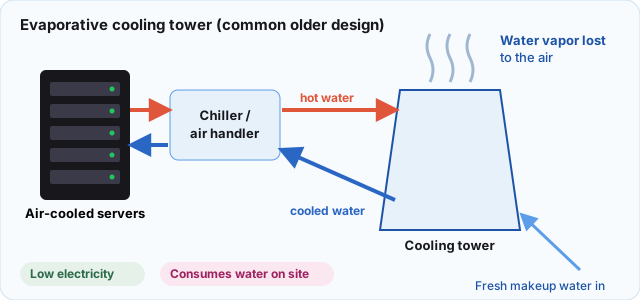
“By 2023, hyperscale and colocation account for 84% of the 66-billion-liter total, while internal data centers fell to just 12%, driven by water efficiency improvements.”[6]Lawrence Berkeley National Laboratory, on U.S. data centers’ direct (on-site) water use, which it says is “primarily associated with cooling infrastructure.” As of Dec 2024.
Timeline
From liquid to air, and back again
1967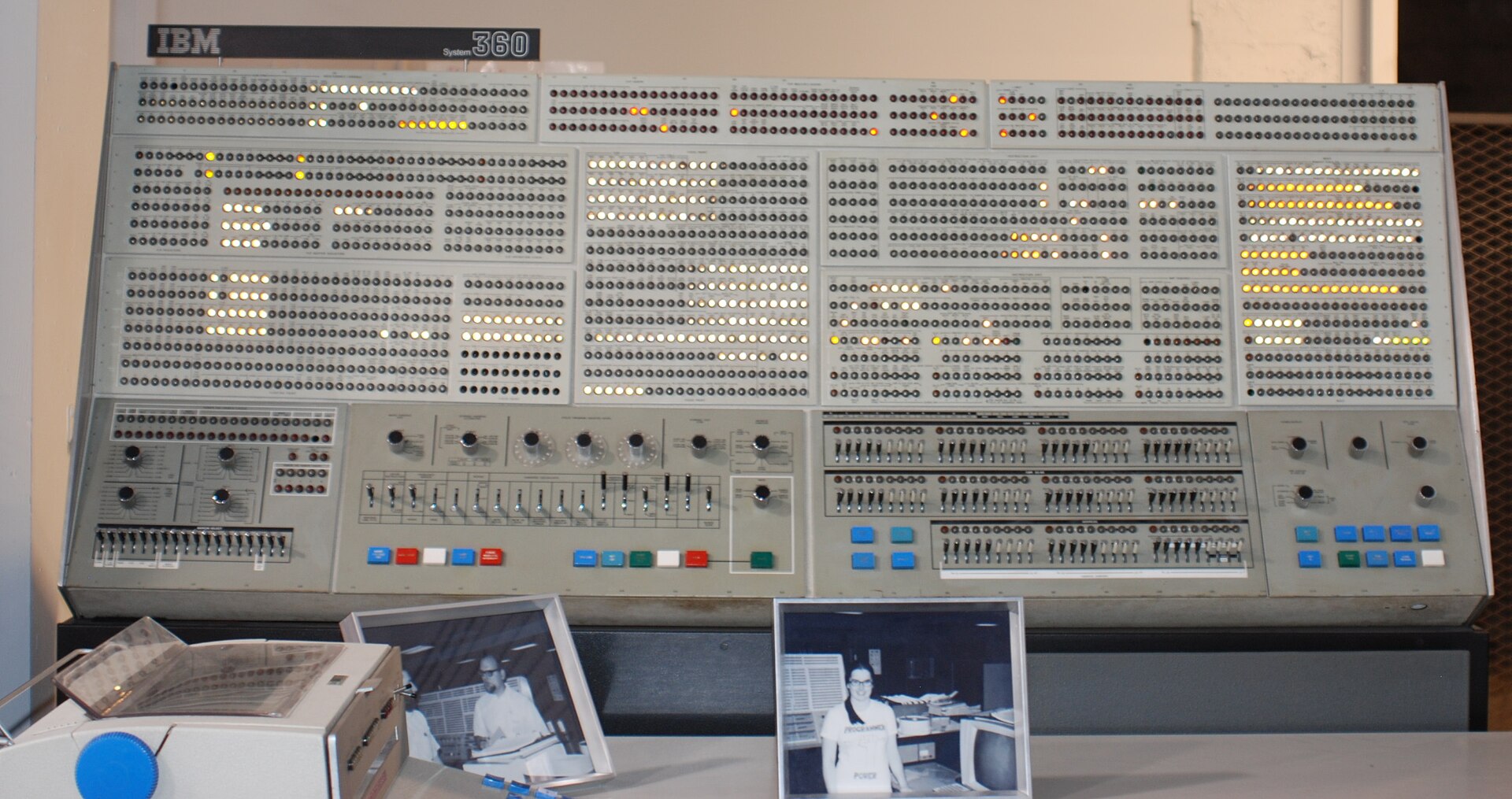
Liquid from the start
IBM’s System/360 Model 91 used a hybrid air-to-water design: a coolant distribution unit with pumps and a heat exchanger moved 40–79 kW of its heat into building water.[1]
Front panel of an IBM System/360 Model 91, as displayed at the Living Computer Museum, Seattle. Photo: MBlairMartin, CC BY-SA 4.0, via Wikimedia Commons Early 1980s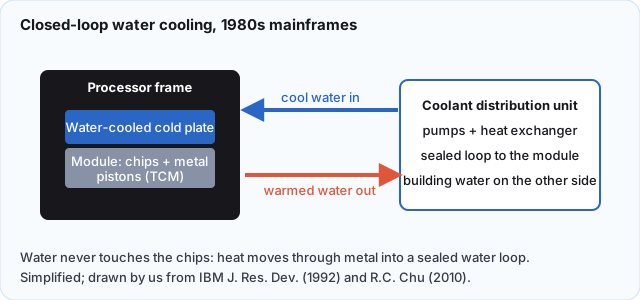
Water-cooled modules
IBM’s Thermal Conduction Module, used in its 3081 and later ES/9000 systems, carried chip heat through metal into water-cooled plates.[1]
Diagram drawn by us from the source cited. 1985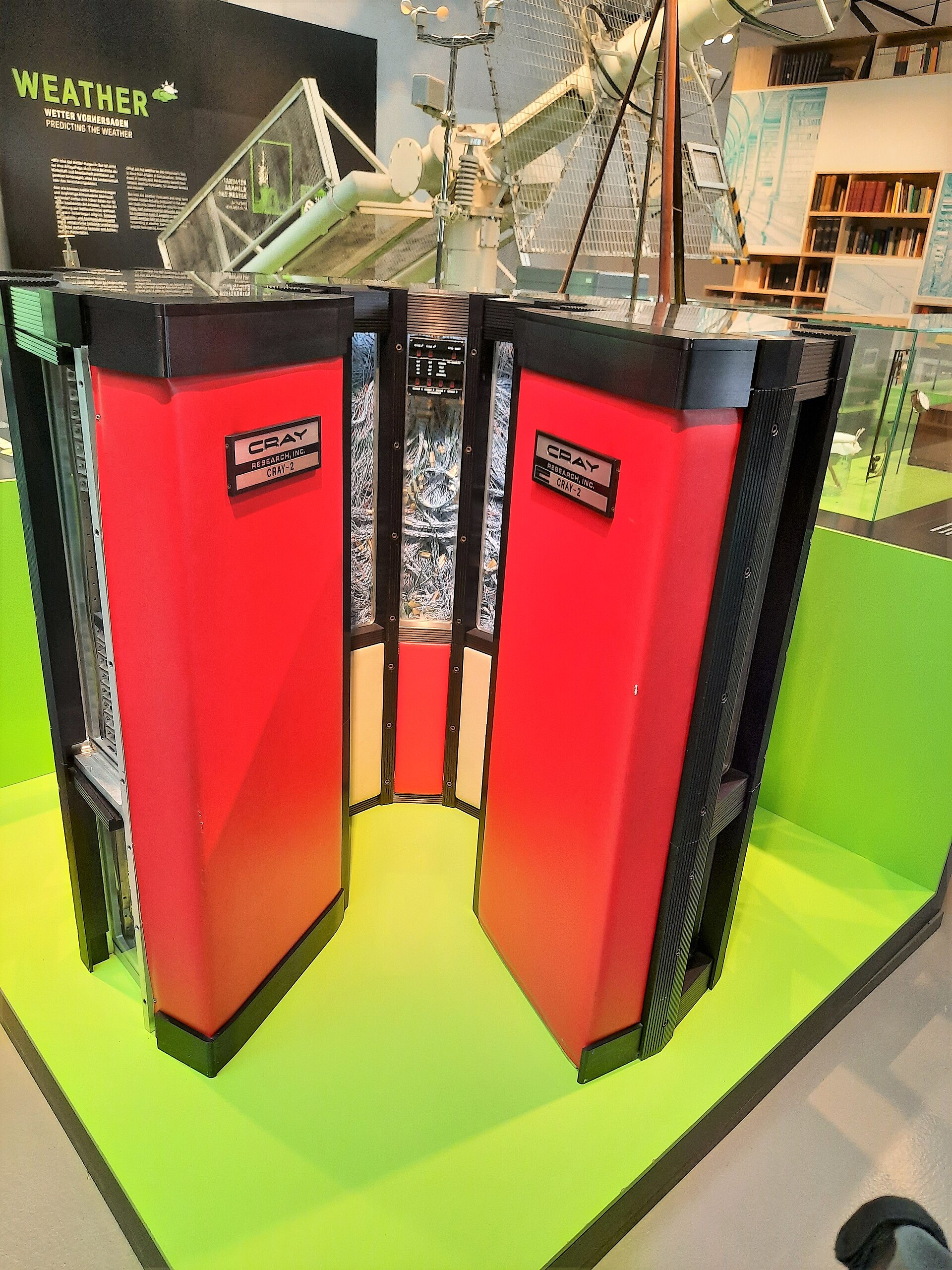
Computers in a bath
The Cray-2 supercomputer’s circuit boards were immersed in Fluorinert, a liquid that does not conduct electricity.[7]
A Cray-2 supercomputer at the Museum für Verkehr und Technik, Berlin, 2022. Photo: Fridolin freudenfett, CC BY-SA 4.0, via Wikimedia Commons Early 1990sMostly water
In IBM’s water-cooled ES/9000 processors, about 80% of the heat went to a closed-loop water system, supplied at 21.7°C (about 71°F). As of July 1992.[3]
Diagram drawn by us from the source cited. Mid-1990s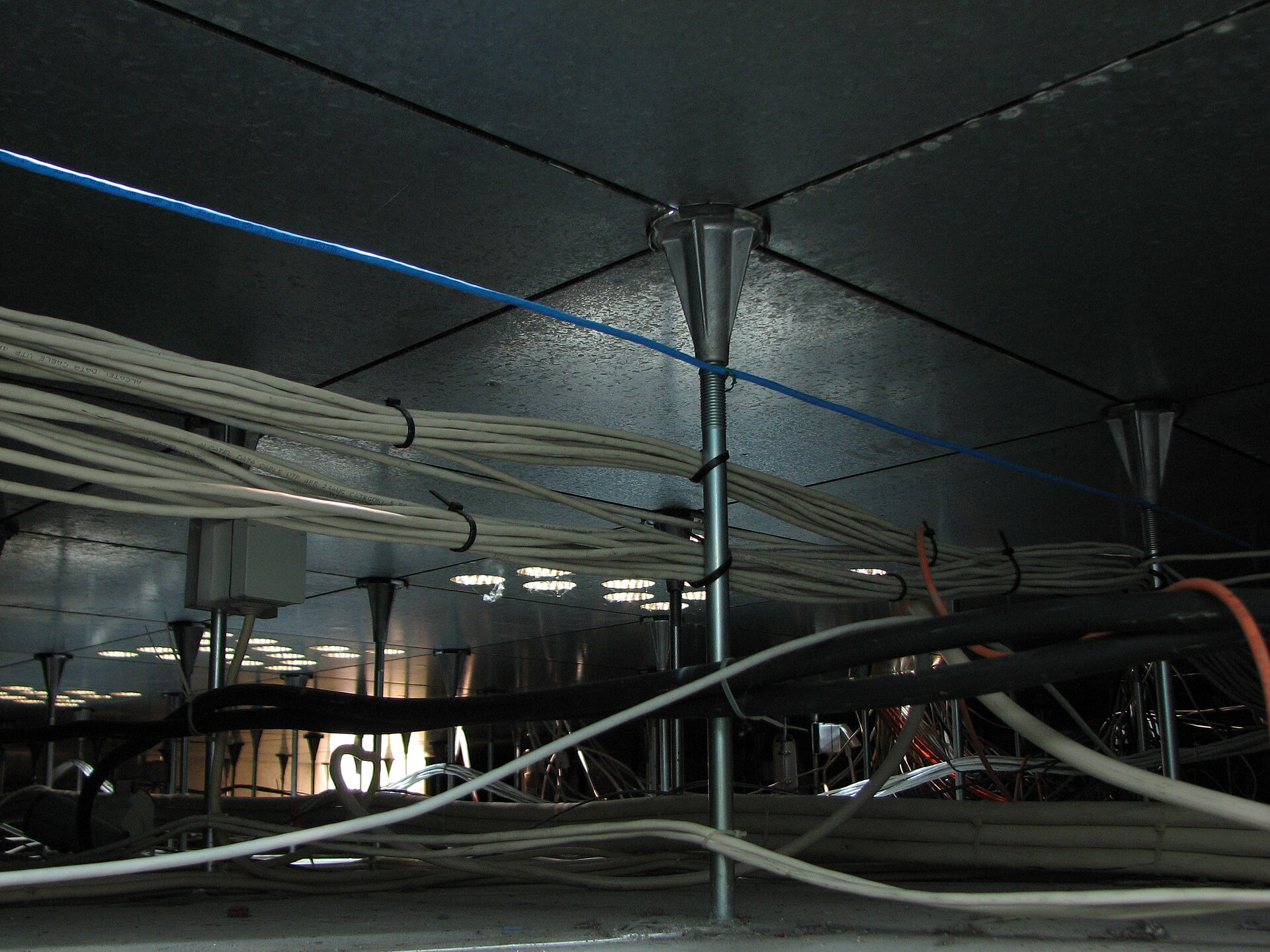
Air takes over
Lower-power CMOS chips let IBM’s servers go fully air-cooled.[1]
Under the raised floor of a data center, 2008. Photo: Adamantios, CC BY-SA 3.0, via Wikimedia Commons 2013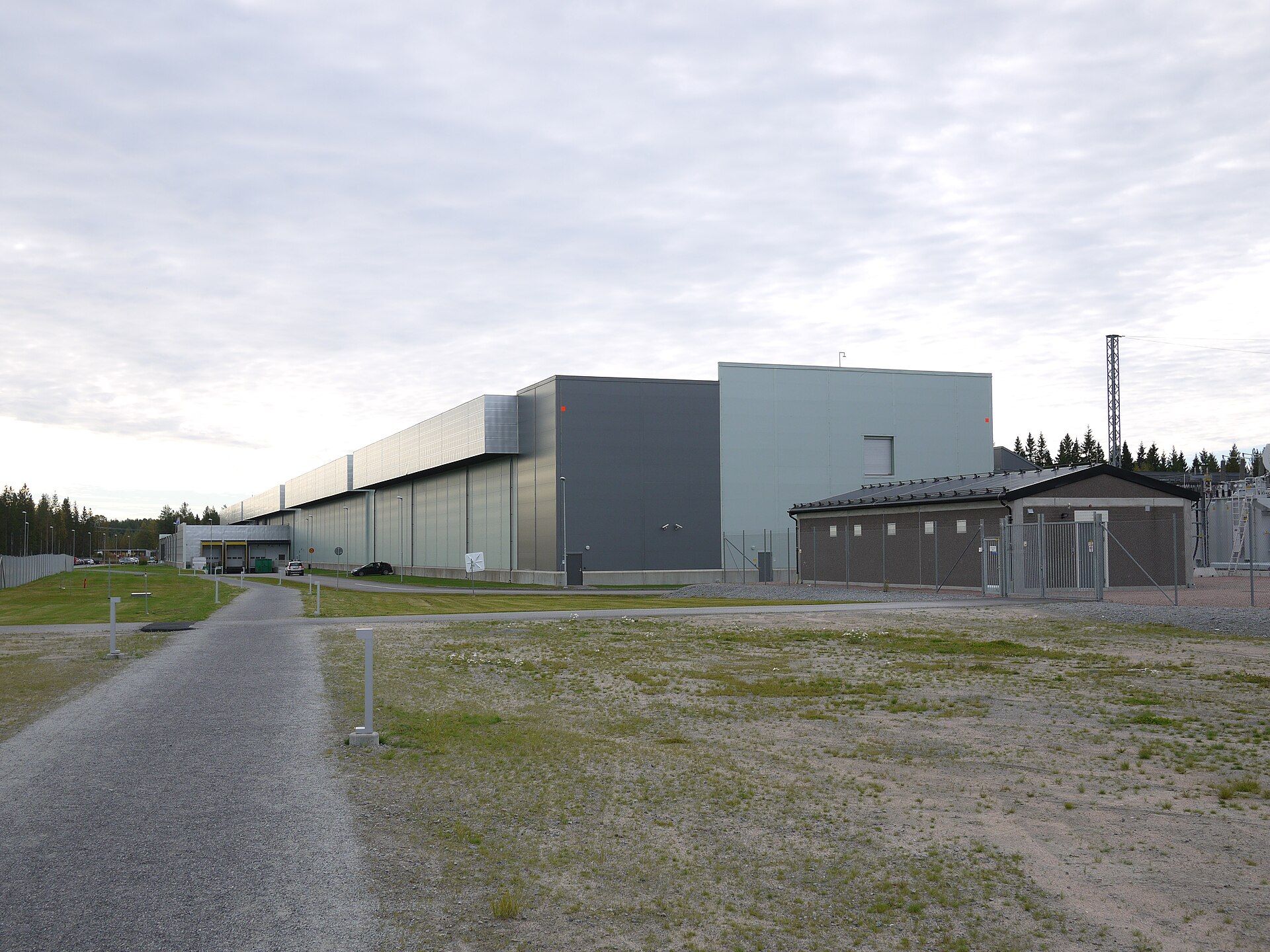
Outside air
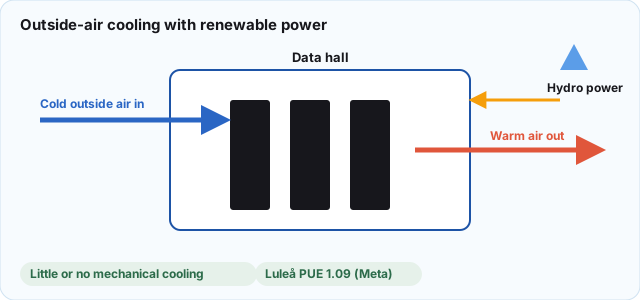
Meta’s Luleå, Sweden data center went live in June 2013 using “chilly Nordic air” to cool its servers and 100% renewable local hydroelectric power.[8]
In early tests, Meta said it averaged a PUE “in the region of 1.07” (as of Jun 12, 2013).[8]
Meta’s data center in Luleå, Sweden, photographed in 2016. Meta says it is cooled with outside air and runs on local hydroelectric power.[8] Photo: Christopher Down, CC BY 4.0, via Wikimedia Commons 2013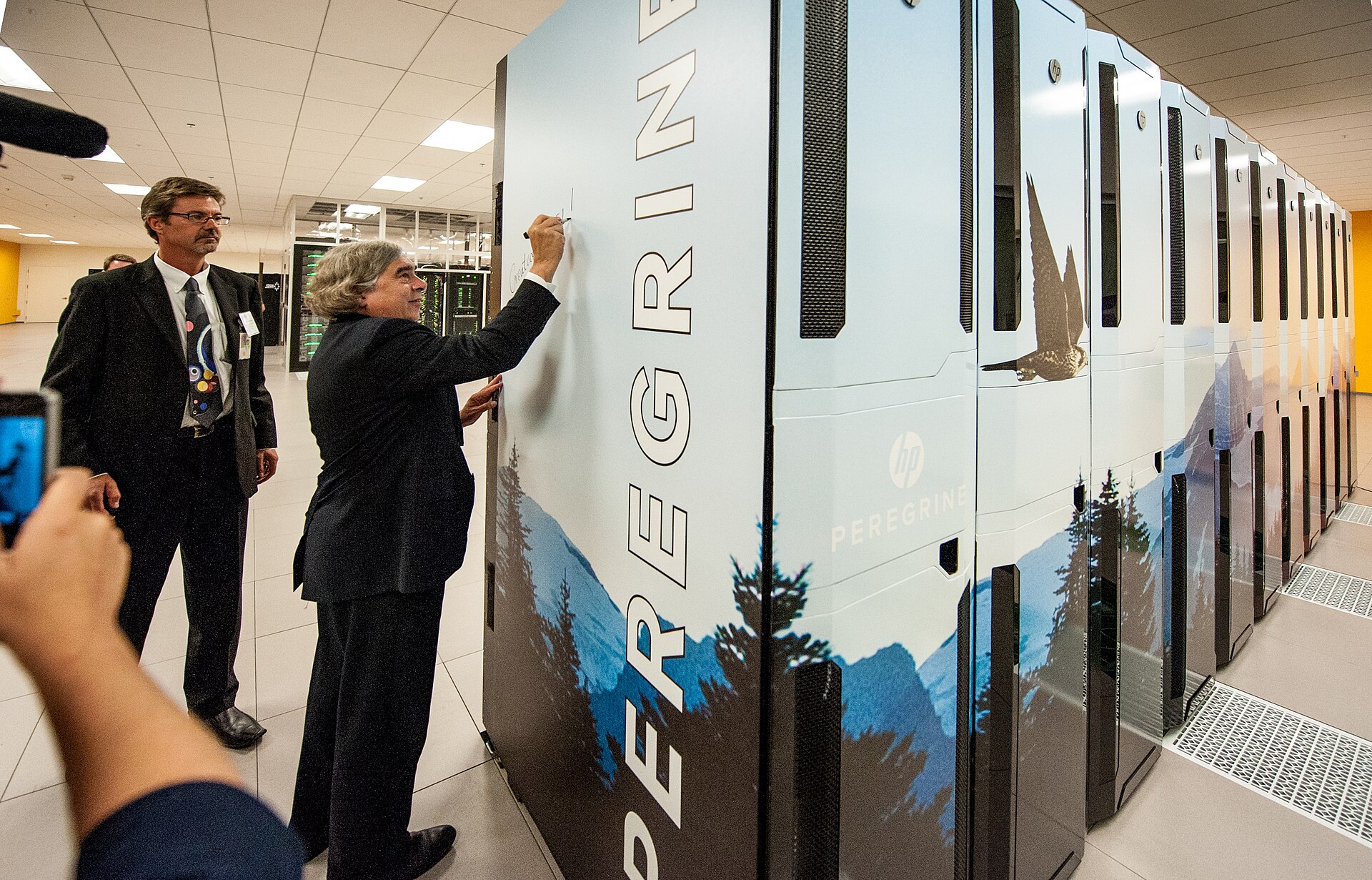
Water comes back
NREL’s data center in Golden, Colorado uses warm-water liquid cooling, and its captured heat warms the building’s offices and other spaces.[9]
NREL reports an annualized PUE of 1.036, compared with an average of around 1.8 that it cites for data centers (undated page, checked Oct 25, 2026).[10]
Unveiling the warm-water, liquid-cooled Peregrine supercomputer at NREL’s data center in Golden, Colorado, 2013. Photo: U.S. Department of Energy, Public domain, via Wikimedia Commons 2017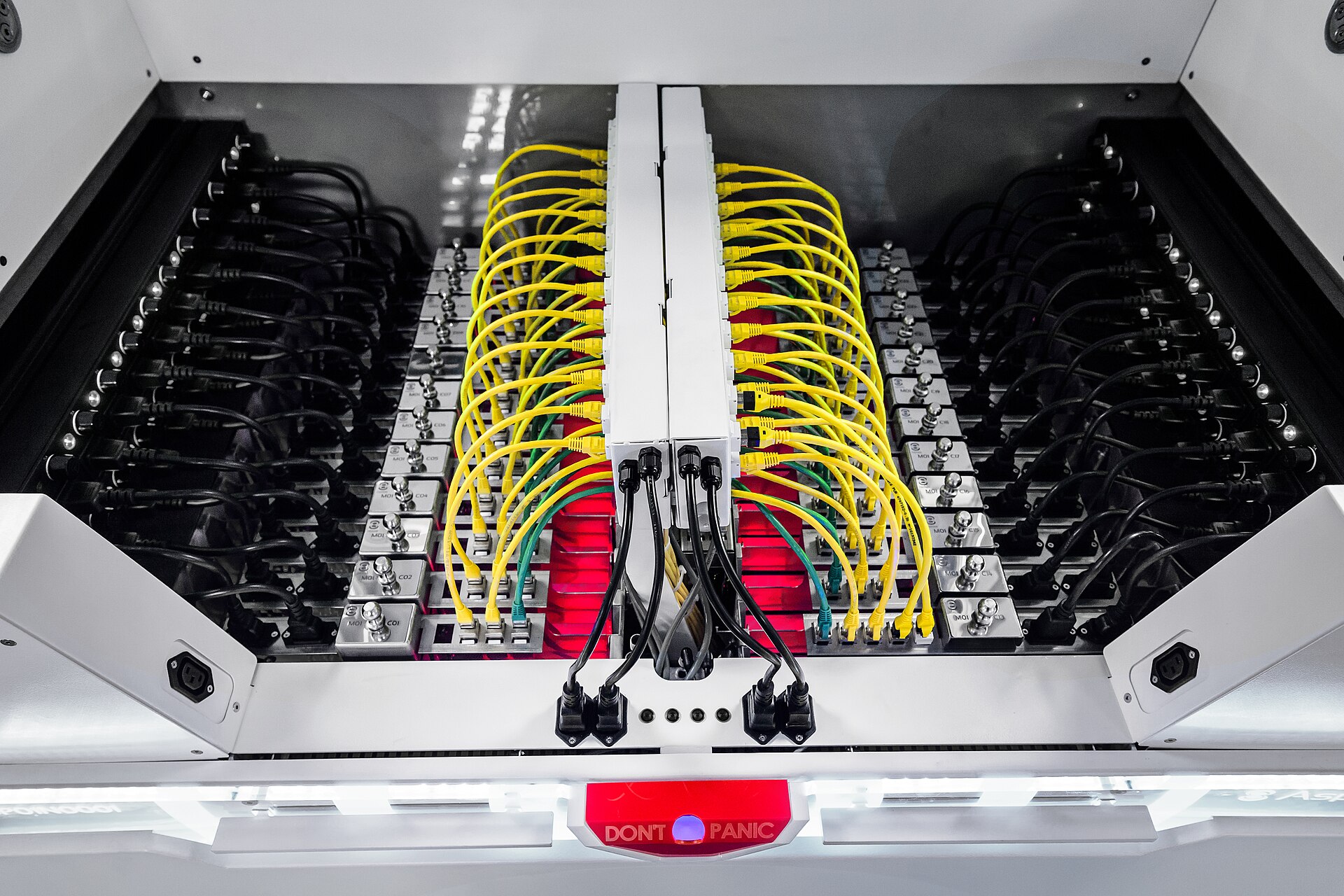
Immersion returns
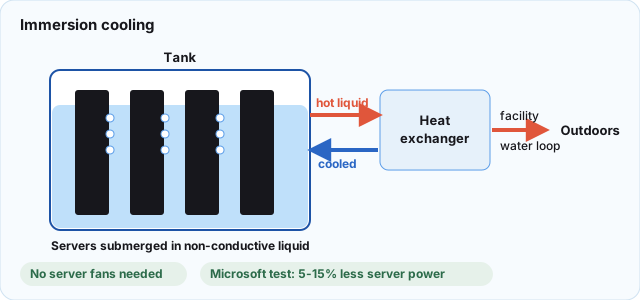
Whole servers can sit in a liquid that does not conduct electricity.[11]
Microsoft reported in April 2021 that two-phase immersion cut an individual server’s power use by 5% to 15% in tests in Quincy, Washington.[11]
An immersion-cooling tank, 2017. Servers sit in a liquid that does not conduct electricity.[11] Photo: Rolf Brink, CC BY-SA 4.0, via Wikimedia Commons 2022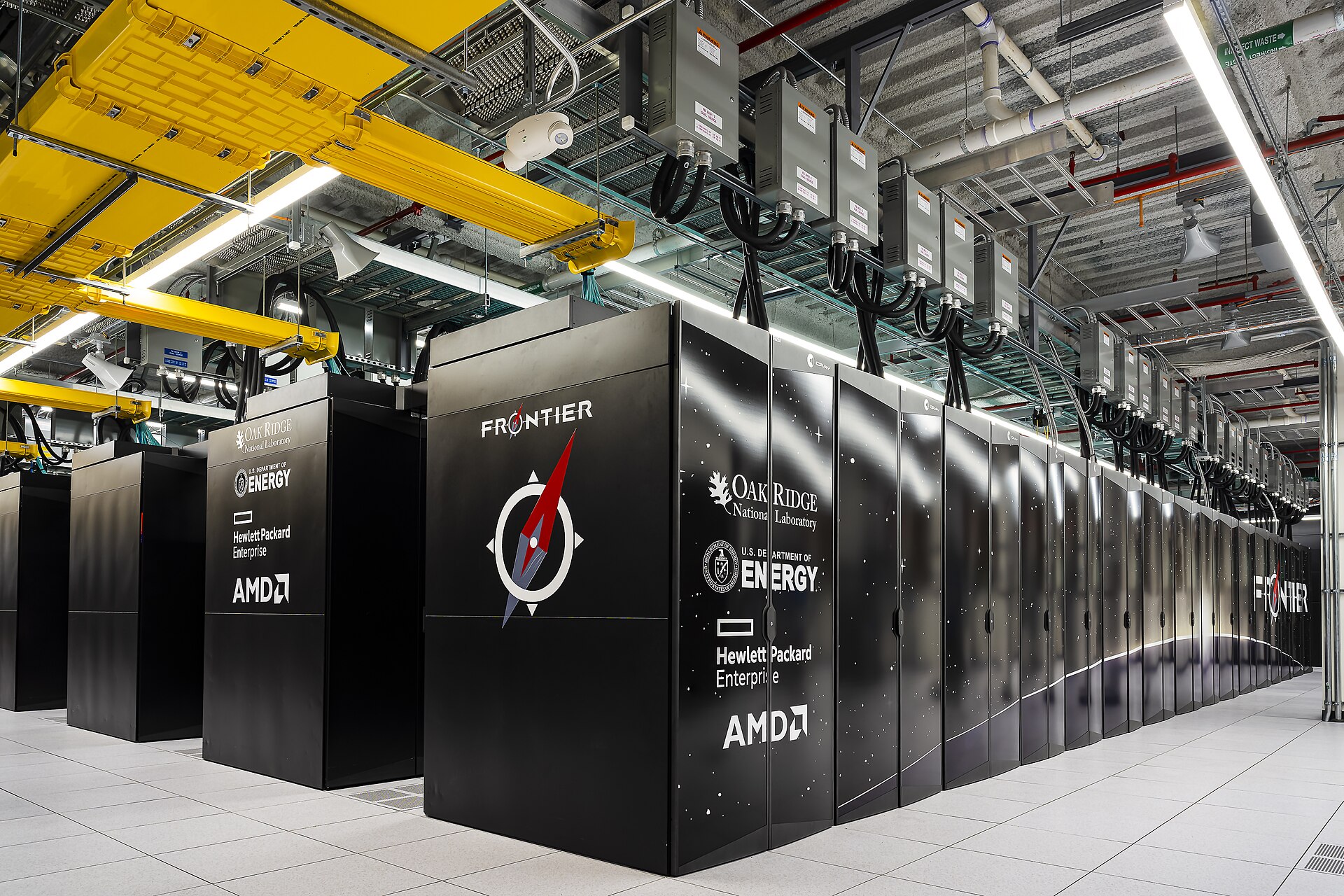
Warm water at supercomputer scale
ORNL’s Frontier supercomputer is cooled with warm water, targeted at about 90°F (32°C), so it needs no refrigeration and is cooled by evaporative towers instead (as of Sep 10, 2024).[12]
Frontier at Oak Ridge National Laboratory, 2022. It is cooled with warm water and no chillers.[12] Photo: Oak Ridge National Laboratory, CC BY 2.0, via Wikimedia Commons 2025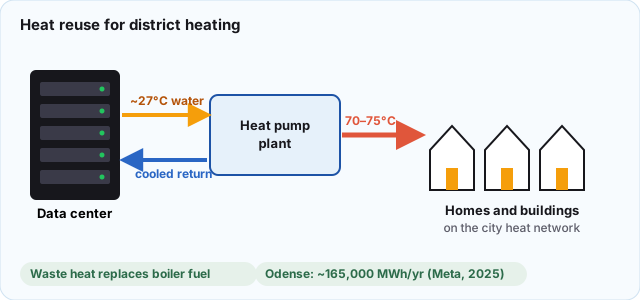
Heating homes
Meta says its Odense, Denmark data center delivers about 165,000 MWh of surplus heat a year to Fjernvarme Fyn’s district heating network, enough for about 9,000 households (as of Feb 2025).[5]
Diagram drawn by us from the source cited. 2026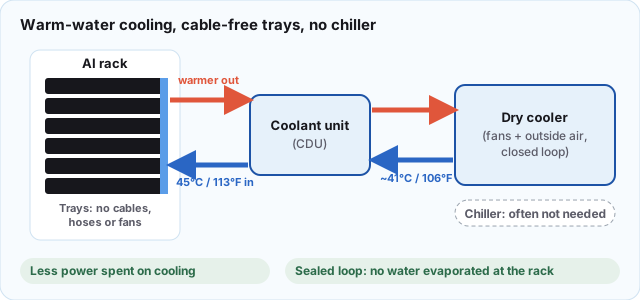
AI racks with no fans or hoses in the trays
Nvidia says its Vera Rubin rack is 100% liquid-cooled, with cable-free, hose-free and fanless trays, and accepts coolant as warm as 45°C (113°F). Nvidia’s own figures, as of Mar 16, 2026.[2]
Diagram drawn by us from the source cited. Next?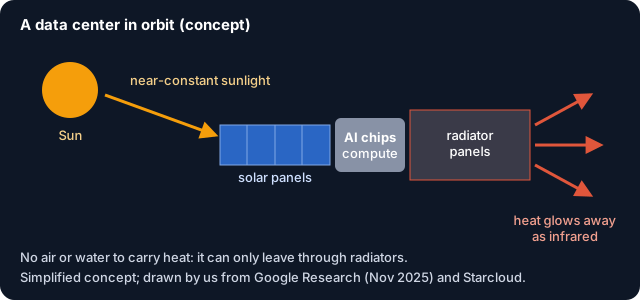
Breaking the cycle?
Some companies are now testing computers in orbit. Google says satellites in a dawn–dusk orbit would get near-constant sunlight for power.[13]
Starcloud says its satellites shed heat by radiating it into space, with no water.[14]
Google lists challenges including thermal management, on-orbit reliability, radiation and launch costs.[13]
Starcloud-1 carried an Nvidia H100 GPU into orbit in November 2025.[15]
On Oct 1, 2026, Google said a Project Suncatcher prototype with its TPU chips, built with Planet, had reached orbit on the Transporter-18 rideshare mission.[16]
SpaceX applied to the FCC on Jan 30, 2026 for a “SpaceX Orbital Data Center system” of up to one million satellites. The FCC accepted the application for filing on Feb 4, 2026, which is not an approval.[17]
All are early tests or plans as of Oct 25, 2026.[16,15,17]
Diagram drawn by us from the sources cited. Good to know
Why water and electronics can mix now
Closed loops
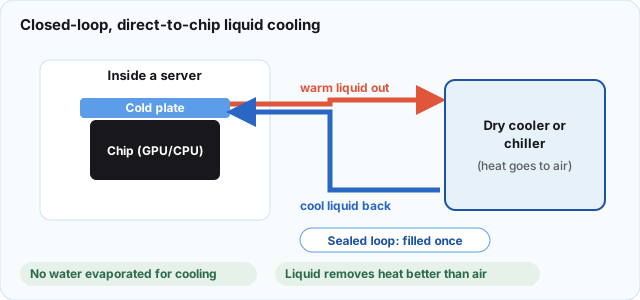
In cold-plate systems, coolant flows in a closed loop through metal plates mounted on the chips, rather than over the electronics.[18,4]
Dripless connectors
Industry-standard quick disconnects are designed to be “drip free” and hot-pluggable, sealing both sides when unplugged.[19]
Leak detection
Leak sensors in compute and switch trays report to the building management system, which can trip a rack’s power breaker and close its coolant shutoff valve.[20]
Carefully chosen coolants
Nvidia specifies PG25, about 75% water and 25% propylene glycol, for its cold-plate loops.[18]
Industry guidelines start from deionized or reverse-osmosis water and call for ongoing checks of conductivity.[21]
Fluids that do not conduct
Immersion systems use dielectric liquids, so whole servers can sit right in them.[11]
Leaks can still happen. Operators treat them as a risk to design for and manage, not one that has gone away.